Interactive Research Summary

Why Incremental Reforms Always Fail

A quantitative model proving that algorithmic discrimination operates as a synergistic barrier system — where fixing one thing fixes nothing.

01 — The Problem

Discrimination That Resists Every Fix

Algorithmic systems now gatekeep employment, housing, credit, and healthcare. Despite audits, regulations, and reforms — discrimination persists. Why?

Improve data accuracy — discrimination continues. Provide legal aid — discrimination continues. Mandate algorithmic audits — discrimination continues. Every single-target reform fails. We hypothesized this isn't a magnitude problem but a structural one: the barriers reinforce each other synergistically.

11
Sequential barriers modeled across 3 interacting layers
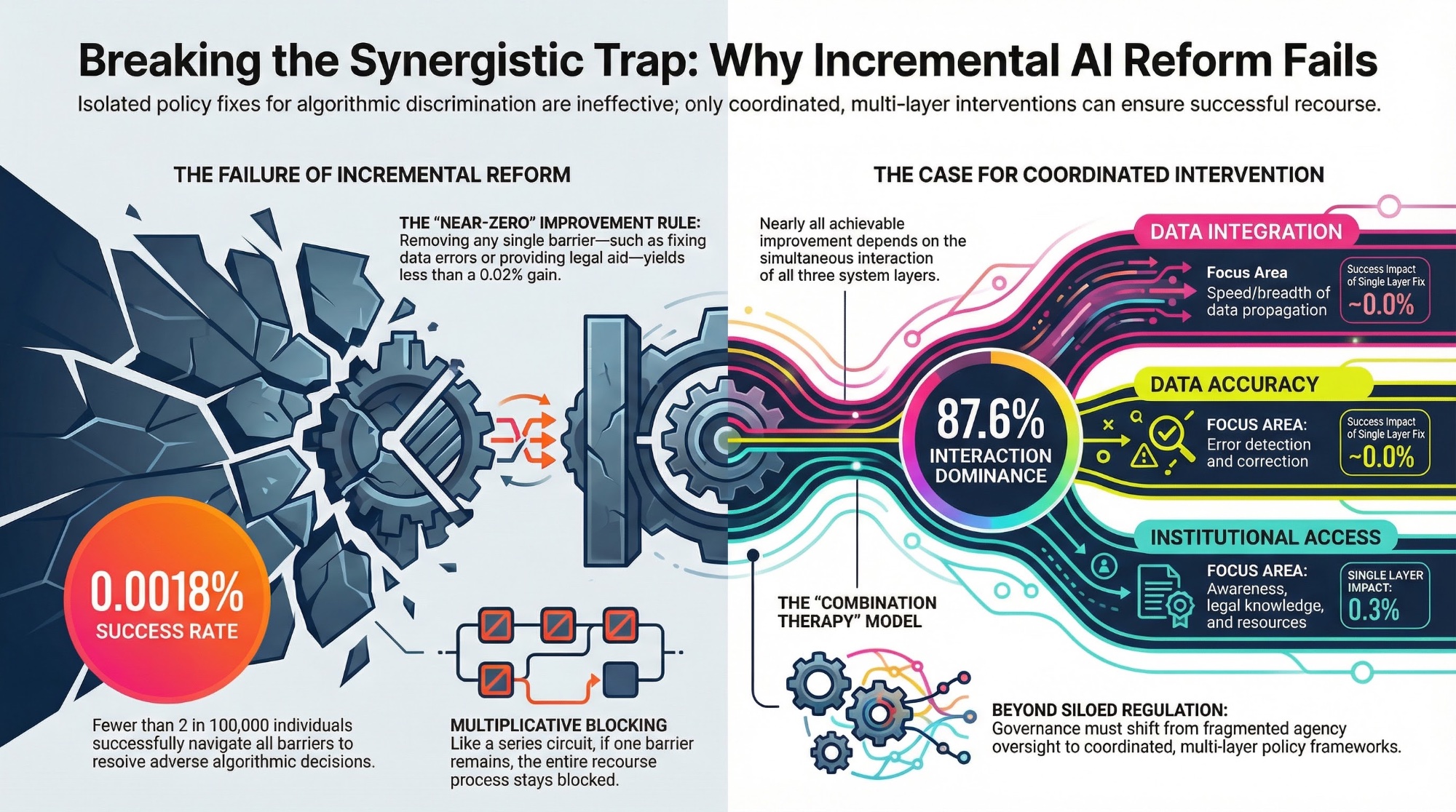
0.0018%
Baseline success rate — fewer than 2 in 100,000
<0.02%
Best single-barrier fix — negligible improvement
02 — The Barrier System

Three Layers That Multiply

We modeled algorithmic discrimination as a multiplicative cascade across three interacting layers. Each barrier has an empirically derived pass probability from federal datasets and peer-reviewed audits.

Layer 1 — Data Integration

How biased data enters and persists across interconnected systems

Rapid Data Transmission (0.30) · Multi-System Integration (0.55) · Permanent Storage (0.45)

Layer 2 — Data Accuracy

How hard it is to detect, correct, and propagate fixes to erroneous data

Error Detection (0.35) · Correction Process (0.35) · Incomplete Propagation (0.40)

Layer 3 — Institutional Access

The legal and institutional barriers to challenging algorithmic decisions

Awareness Gap (0.30) · Record Access (0.55) · Legal Knowledge (0.25) · Legal Resources (0.40) · Systemic Bias (0.30)
P(success) = ∏i=111 pi = 0.0018%
Multiplicative cascade: barriers don't add — they multiply
03 — The Key Finding

87.6% Interaction Dominance

Factorial decomposition reveals the system is overwhelmingly driven by the three-way interaction between layers — not by individual barriers or even pairwise combinations.

Three-way interaction (L1 × L2 × L3)87.6%
Two-way interactions12.1%
Main effects (individual layers)0.3%

The barriers don't just coexist — they amplify each other. Fixing data accuracy without fixing institutional access doesn't help, because the interaction between them maintains the barrier. This is why every reform targeting a single layer fails: you're addressing 0.3% of the problem while 87.6% remains structurally intact.

04 — Strategy Equivalence

Order Is Irrelevant. Only Completeness Matters.

We compared four barrier removal strategies: forward, backward, greedy by marginal impact, and random. All produce the same hockey stick curve — near-zero improvement until the final 2–3 barriers are removed.

F = 0.07
ANOVA across strategies — p = 0.98
100%
Bootstrap robustness (n = 1,000)

This is exactly how drug resistance works in infectious disease. Incomplete antiretroviral therapy doesn't partially suppress HIV — it selects for resistance. Similarly, incomplete policy reform doesn't partially reduce algorithmic discrimination — it leaves the synergistic structure intact.

05 — Policy Implications

From Siloed Regulation to Coordinated Reform

The current regulatory architecture mirrors the barrier fragmentation: CFPB handles credit, EEOC handles employment, HHS handles healthcare algorithms. Our model demonstrates this siloing is mathematically guaranteed to fail.

Coordinated, simultaneous intervention across all three layers. Not sequential reform, not prioritized reform, not incremental reform. The three-way interaction means that any partial approach leaves the synergistic structure intact. Multi-agency coordination isn't just good policy — it's the only policy the mathematics permit.

All barrier parameters traced to CFPB, FTC, LSC federal data and peer-reviewed audits · Shapley value decomposition identifies Legal Knowledge Gap (11.3%) and Rapid Data Transmission (11.1%) as top contributors · Signal-to-noise ratio confirms robustness up to ~25% parameter noise · Global sensitivity analysis (Sobol indices + Morris screening) confirms interaction-dominant dynamics across full uncertainty range

Resources

Explore the Research

Slide 1
1 / 20

↓ Download PPTX

Breaking the Synergistic Trap: Why Incremental AI Reform Fails
Question

Answer

Preprint Citation

Demidont AC. Algorithmic Discrimination as a Synergistic Barrier System: Formal Mathematical Propositions for Multi-Layer Healthcare AI Bias. medRxiv 2026. doi: 10.64898/2026.02.22.26346836

BibTeX

@article{Demidont2026algo,
  author = {Demidont, A.C.},
  title = {Algorithmic Discrimination as a Synergistic Barrier System: Formal Mathematical Propositions for Multi-Layer Healthcare AI Bias},
  journal = {medRxiv},
  year = {2026},
  doi = {10.64898/2026.02.22.26346836}
}